Zirconia Crowns vs Porcelain Crowns: Which Is Best?
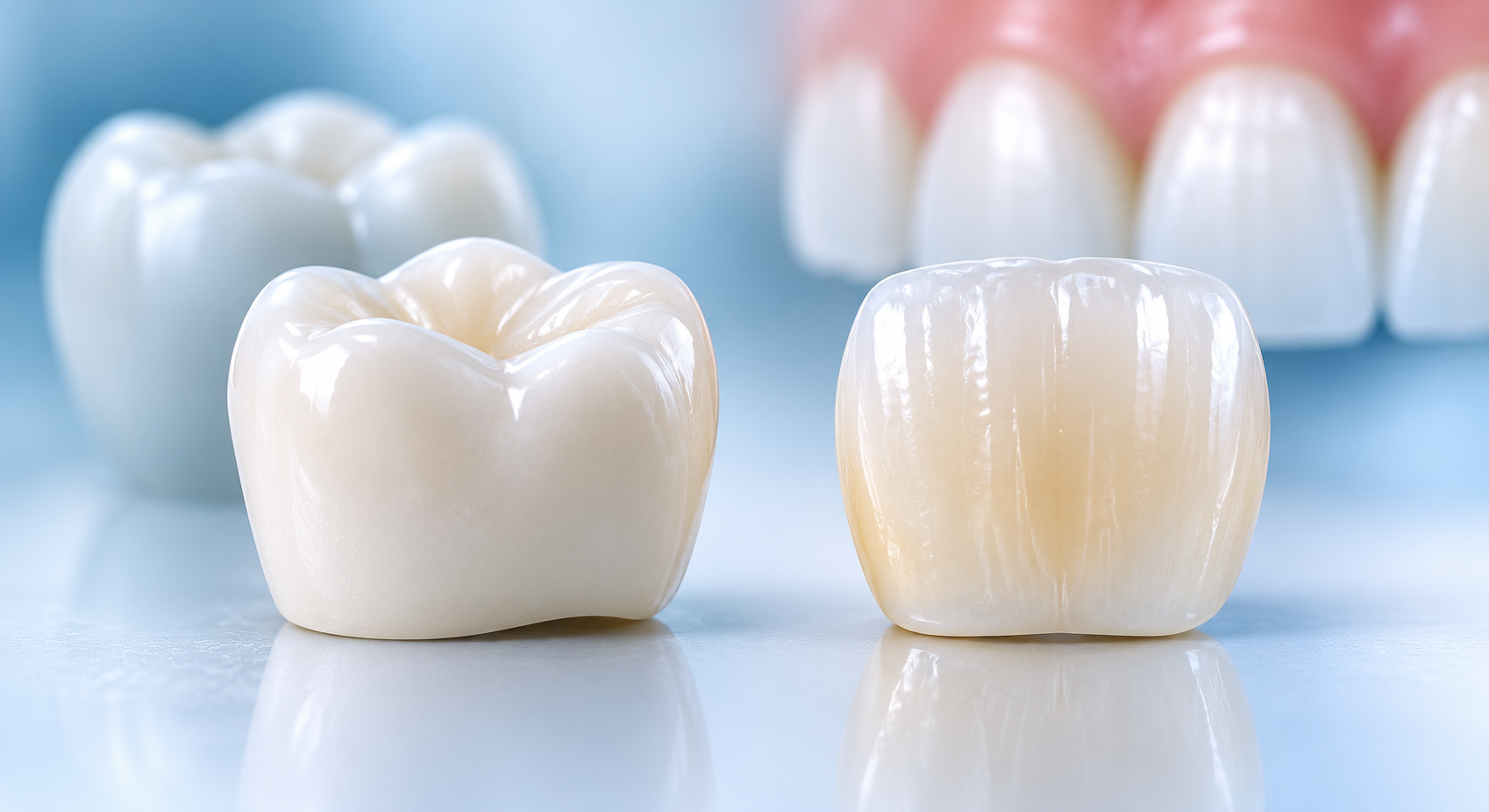
"Porcelain crown" can mean feldspathic porcelain, porcelain fused to metal, porcelain layered over zirconia or a lithium disilicate glass ceramic.
That loose label is why most comparisons of zirconia crowns vs porcelain crowns stay vague. This guide uses clear categories, current survival data and the prep numbers you need at the chair.
Zirconia crowns vs porcelain crowns: the quick answer
Zirconia crowns are stronger and chip far less, especially in a monolithic (full contour) design, so they suit molars, heavy biters and tight spaces. Porcelain crowns, layered or lithium disilicate, offer more translucency and surface character, so they suit front teeth and shade-critical cases. Recent survival data shows both perform well at five years.
The best choice comes down to the tooth, the bite and the room you have to work with. The sections below give the numbers behind each of those.
What counts as a porcelain crown?
Four different restorations travel under the "porcelain" label. Ask which one is meant before comparing it with zirconia, because their strength and chipping risk differ widely.
|
Type |
What it is |
Where it works well |
Watch out for |
|
Feldspathic porcelain |
Glass-based porcelain with no supporting core |
Highly esthetic anterior work and thin veneers |
The lowest strength of the group |
|
Porcelain fused to metal (PFM) |
Porcelain over a cast metal coping |
Long clinical track record, including bridges |
Metal can show at the margin, and porcelain can chip |
|
Porcelain fused to zirconia (layered zirconia) |
Porcelain built up by hand over a milled zirconia core |
Front teeth and premolars that need character over a strong core |
The veneering porcelain can chip |
|
Lithium disilicate (E.max) |
A glass ceramic often called porcelain, with a biaxial flexural strength of 530 MPa |
Single crowns, veneers, inlays and onlays |
Needs at least 1 mm of material, and a dark stump can show through |
From here on, this guide names the porcelain type each time, so the comparison with zirconia stays fair.
What is a zirconia crown?
A zirconia crown is made from zirconium dioxide, a dense ceramic that is milled and then sintered. It comes in two designs:
- Monolithic (full contour): milled from a single piece, with no porcelain on top, then stained and glazed or polished
- Layered: porcelain built up by hand over a zirconia core, the same restoration as porcelain fused to zirconia in the table above
Strength vs translucency: zirconia comes in generations
"Zirconia" covers several formulas, and each one trades strength for translucency. A 2022 review in Molecules sums up the pattern:
- 3Y-TZP (the original): flexural strength of 1,200 to 1,500 MPa, and the least translucent
- 4Y and 5Y zirconia: more of the cubic phase, so more light passes through and strength falls, an inverse relationship the review reports across in vitro studies
- 5Y limits: the review advises against using it for posterior bridges longer than three units
- Thickness matters: translucent zirconia thicker than 0.5 mm stays mostly opaque and less translucent than lithium disilicate
When a colleague says zirconia looks flat, the formula and the thickness usually explain it. Multilayer blocks that grade from a stronger cervical zone to a more translucent incisal zone have narrowed the gap with porcelain.
Zirconia vs porcelain crown: side-by-side comparison
For a quick crown zirconia vs porcelain check: monolithic zirconia wins on strength and chipping. Layered porcelain wins on esthetic control, and lithium disilicate sits between the two.
|
Factor |
Monolithic zirconia |
Layered porcelain (over zirconia or metal) |
Lithium disilicate |
|
Material strength |
1,200 to 1,500 MPa for 3Y-TZP |
Strong core; the porcelain layer is the weak point |
530 MPa |
|
Esthetics |
Good, best with multilayer blocks; more opaque as thickness grows |
The most control over translucency and character |
Lifelike translucency for single units |
|
Chipping risk |
Very low |
The highest of the three |
Low in monolithic form |
|
Reduction |
Minimum preparation depths of 0.8 to 1.0 mm, shoulder with rounded inner edges or chamfer |
More than monolithic, since the core and the porcelain both need room |
At least 1 mm of material |
|
Cementation |
Conventional or self-adhesive on retentive preps; adhesive with an MDP-containing primer when retention is short |
Follows the core material |
Hydrofluoric acid etch and silane, then adhesive or self-adhesive cement |
|
Wear on opposing enamel |
Polished surfaces wear enamel less than glazed ones |
Feldspathic porcelain tends to wear enamel more than zirconia |
Similar to monolithic zirconia in lab studies |
|
Typical use |
Molars, bruxers, tight space, posterior bridges |
Front teeth and shade-critical crowns |
Anterior and premolar crowns, veneers, inlays and onlays |
What does the research say about survival and chipping?
At five years, every modern crown type survives above 95%, except feldspathic porcelain at 90.4%. The real difference is chipping. These figures come from a 2026 systematic review and meta-analysis of tooth-supported single crowns:
|
Crown type |
5-year survival |
Ceramic chipping or fracture |
Core or substructure fracture |
|
Monolithic lithium disilicate |
98.5% |
1.7% |
0.7% |
|
Layered zirconia |
97.3% |
7.9% |
0.8% |
|
Metal-ceramic (PFM) |
97.1% |
5.5% |
0.08% |
|
Monolithic zirconia |
96.8% |
0.4% |
0% |
|
Layered leucite or lithium disilicate glass ceramic |
95.7% |
5.7% |
2.1% |
What the numbers mean at the chair
- Monolithic designs chip the least. Monolithic zirconia (0.4%) and monolithic lithium disilicate (1.7%) sit well below every layered option (5.5% to 7.9%).
- Survival is close across modern options. The authors conclude that monolithic lithium disilicate and monolithic zirconia match metal-ceramic crowns at five years, and that metal-ceramic is no longer justified as the gold standard.
- Lithium disilicate leads the all-ceramics. The review names monolithic lithium disilicate the new reference material for all-ceramic single crowns.
Read these caveats too
- The monolithic zirconia estimate rests on a small evidence base, with a wide confidence interval (92.6% to 98.6%).
- Monolithic designs showed more marginal discoloration, though the monolithic zirconia figure came from one study of 30 crowns.
- Five-year data is the strongest available. Lifespans quoted in decades rest on thinner evidence, so treat them with care when patients ask.
Which crown fits which case?
Start from the tooth and the bite, then pick the material. Monolithic zirconia covers most posterior work, and layered porcelain or lithium disilicate covers most shade-critical anterior work.
|
Case |
Usually the better fit |
Why |
|
Molars and heavy chewing load |
Monolithic zirconia |
The highest strength and the lowest chipping rate |
|
Bruxism or a history of chipped porcelain |
Monolithic zirconia, polished, with a night guard |
No porcelain layer to chip, and polished surfaces are kinder to enamel |
|
Limited occlusal clearance |
Monolithic zirconia |
Works with less reduction than layered options |
|
Premolars in the smile line |
Multilayer zirconia or lithium disilicate |
A balance of strength and translucency |
|
Single central incisor |
Layered porcelain or lithium disilicate, with a custom shade visit |
The most control over character next to a natural tooth |
|
Dark or discolored stump |
Layered zirconia or a less translucent zirconia, with the stump shade on the RX |
Translucent materials let the stump color show through |
|
Posterior bridge |
3Y zirconia, monolithic or layered |
5Y zirconia isn't advised for posterior bridges longer than three units |
|
Patient asks for metal-free |
Any all-ceramic option |
Zirconia, lithium disilicate and feldspathic porcelain contain no metal |
As the architect Louis Sullivan put it, form follows function. The job a tooth does should pick its crown, ahead of any label on the box.
How do prep and cementation differ?
Zirconia forgives a thinner prep and offers conventional cementation on retentive teeth. Lithium disilicate needs more room and an etch-and-silane bonding protocol. Layered crowns need the most room of all.
Preparation
- Monolithic zirconia: Ivoclar lists minimum preparation depths of 0.8 to 1.0 mm for monolithic zirconia crowns, with a shoulder with rounded inner edges or a chamfer
- Lithium disilicate: crowns need at least 1 mm of material, and Ivoclar allows that minimum when the crown is bonded adhesively
- Layered porcelain: the core and the porcelain both need space, so plan more reduction than for monolithic zirconia and check your lab's guide
Cementing zirconia
- Air-abrade the intaglio with 25 to 70 µm aluminum oxide at no more than 1 bar, as Ivoclar specifies.
- Clean after try-in, since saliva contaminates the bonding surface.
- On a retentive prep, a glass ionomer, RMGI or self-adhesive cement works.
- On a short or tapered prep, bond with a primer that contains MDP. Silane alone can't bond to oxide ceramics, and hydrofluoric acid does little for zirconia.
Cementing lithium disilicate
- Etch the intaglio with 5% hydrofluoric acid for 20 seconds.
- Apply silane for 60 seconds and air-dry.
- Bond with an adhesive or self-adhesive resin cement.
Ask your lab whether it air-abrades or etches before shipping, so a step is neither repeated nor skipped.
How do you get the shade right with either material?
Both materials can match well when the lab sees what you see. The material sets the tools the technician has; your records decide how well they're used.
- Send the stump shade. Lithium disilicate and translucent zirconia let the prep color show through, so a dark stump changes the final shade.
- Take photos with a shade tab in the shot, in natural light, alongside the written shade.
- Match the material to the tooth. Layered porcelain lets the ceramist build translucency and character inside the crown. Monolithic zirconia relies on the blank and external stains, and it grows more opaque as thickness increases.
- Book a custom shade visit for single centrals. When the technician sees the tooth in person, a lone central next to natural teeth gets far easier to match.
How Dental Concepts SF makes zirconia and porcelain crowns
Our California dental lab makes both on one RX form, so the material can follow the case. Zirconia is also where we began: in 2006, our founders opened Prestige Milling Inc., one of the first Lava Milling Centers on the West Coast.
- Full contour zirconia crowns: designed digitally on 3Shape, milled on Roland equipment, sintered and finished by hand. Our RX form lists them at 7 in-lab working days for 1 to 3 units.
- Layered porcelain crowns: a ceramist builds the porcelain by hand over a milled zirconia core. Our RX form lists them at 10 in-lab working days for 1 to 3 units, or 15 days for an esthetic crown with a custom shade visit.
- Also on the same RX: lithium disilicate (E.max) and full-cast gold crowns.
Every crown is made in-house in California, final fixed restorations carry a one-year warranty on materials and workmanship (restrictions apply), and the technician on your case is a phone call away. Not sure which material fits a tooth?Talk to the lab or call 1-800-700-LABS.
FAQs
Is a zirconia crown stronger than a porcelain crown?
Yes. 3Y zirconia reaches 1,200 to 1,500 MPa in flexural strength, against 530 MPa for lithium disilicate. In a 2026 meta-analysis, monolithic zirconia crowns chipped in 0.4% of cases at five years, compared with 5.5% to 7.9% for crowns with layered porcelain.
Zirconia crown vs porcelain on a front tooth: which looks more natural?
Layered porcelain or lithium disilicate usually looks more lifelike on a front tooth. Multilayer translucent zirconia has narrowed the gap and makes sense when strength matters, such as in a patient who grinds. Send the stump shade and photos either way.
Do zirconia crowns wear down opposing teeth?
In lab studies, monolithic zirconia wore enamel about as much as lithium disilicate, and polished surfaces caused less wear than glazed ones. Clinical data is limited and varied, so polish every adjusted surface before the patient leaves.
How long do zirconia and porcelain crowns last?
Five-year survival is 96.8% for monolithic zirconia, 97.3% for layered zirconia, 98.5% for monolithic lithium disilicate and 90.4% for feldspathic porcelain. Longer-term figures rest on less data, so set patient expectations with care.
Can you bond a zirconia crown?
Yes. Air-abrade the intaglio, clean it after try-in and use a primer that contains MDP. On a retentive prep, a glass ionomer, RMGI or self-adhesive cement also works.